
Chemical Bonding – Bond Parameters
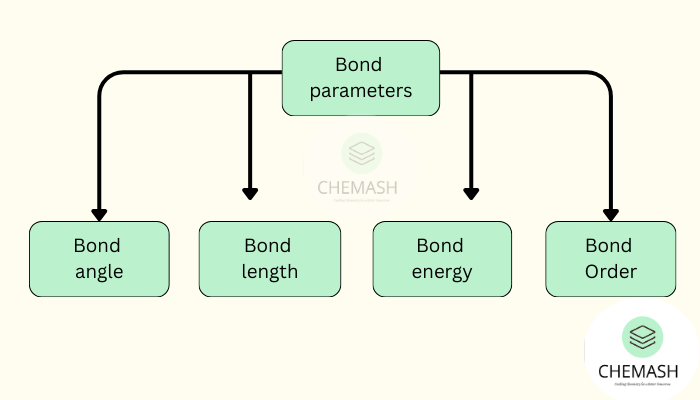
Bond parameters are the measurable properties of chemical bonds that describe their strength, length, and stability. Understanding these helps in predicting molecular shape and reactivity. The key bond parameters are bond length, bond angle, bond enthalpy, bond order, and resonance. Chemical Bonding – Bond Parameters
1. Bond Length
Average distance between the nuclei of two bonded atoms. Depends on atom size and bond type.
- Increases down a group, decreases across a period.
- Triple bond < Double bond < Single bond (in length).
- Example: H–H = 74 pm, C–C = 154 pm.
2. Bond Angle
Angle between two bonds from the same atom, showing molecular shape.
- Affected by lone pairs & hybridization.
- H2O: 104.5° (lone pair repulsion).
- CH4: 109.5° (tetrahedral).
3. Bond Enthalpy (Bond Energy)
Energy required to break one mole of bonds in the gaseous state.
- Measured in kJ/mol.
- Triple bond > Double bond > Single bond (strength).
- Example: H–H = 435 kJ/mol, O=O = 498 kJ/mol.
4. Bond Order
Number of chemical bonds between a pair of atoms, showing stability.
- Single bond = 1
- Double bond = 2
- Triple bond = 3
- Resonance → fractional values (O3 = 1.5)
5. Resonance
When one Lewis structure is not enough, resonance forms are written. The actual molecule is a hybrid.
- Electron delocalization adds stability.
- Examples: O3, CO32–, NO3–.
- Hybrid bond lengths are intermediate.
MCQ Quiz
- Which bond has the shortest bond length?
a) C–C b) C=C c) C≡C
Answer: c) C≡C - Bond angle in CO2 is:
a) 109.5° b) 120° c) 180°
Answer: c) 180° - Higher bond order indicates:
a) Longer bond, weaker strength
b) Shorter bond, higher strength
Answer: b) Shorter bond, higher strength - Which molecule shows resonance?
a) H2O b) CH4 c) O3
Answer: c) O3 - Bond angle in water is less than 109.5° because of:
a) Bond pair-bond pair repulsion
b) Lone pair-lone pair repulsion
Answer: b) Lone pair-lone pair repulsion
FAQs on Bond Parameters
Q1. What is bond length?
It is the average distance between nuclei of two bonded atoms, measured in pm or Å.
Q2. How does bond order affect bond properties?
Higher bond order means shorter and stronger bonds with higher bond energy.
Q3. Why does water have a bond angle of 104.5°?
Due to lone pair repulsion, reducing the angle from the ideal tetrahedral 109.5°.
Q4. Give examples of resonance compounds.
Ozone (O3), carbonate ion (CO32–), nitrate ion (NO3–).

It’s really a cool and helpful piece of info. I am glad that you shared this helpful info with us. Please keep us informed like this. Thanks for sharing.